
Then let our songs abound, and every tear be dry;
We’re marching through Emmanuel’s ground
to fairer worlds on high. – Issac Watts
December 2025; as background for a sermon series from the book of Revelation
Like most of the statements and images of Revelation, there is no universal agreement as to who the 144,000 are. Here are several examples of conclusions as who or what the number references.
Jehovah Witnesses: According to the jw.org website, “God selects a limited number of faithful Christians who, after their death, will be resurrected to life in heaven… The Bible indicates that 144,000 people will be resurrected to heavenly life.”
Seventh Day Adventists: According to the adventistbiblicalresearch.org website, the number is a symbolic way that “portrays the 144,000 as God’s special end time church.”
John MacArthur Study Bible: The 144,000 is a “missionary corps of redeemed Jews who are instrumental in the salvation of many Jews and Gentiles during the Tribulation… By sovereign election, God will seal 12,000 from each of the 12 tribes, promising His protection while they accomplish their mission.”
My understanding: I join a number of Bible believing pastors and scholars from over the centuries who believe the number symbolically refers to true believers in Christ. The 144,000 is a symbolic representation of believers standing for Christ in this life. It represents the true church in battle – standing firm against the schemes of the devil; resisting him firm in their faith; advancing the message of Christ to all peoples – confident in their day of victory. Like the men from the tribes of Israel numbered for the purpose of doing battle, the first half of this vision (7:1-8) symbolically speaks of the church militant. The second half (7:9-17) reveals the church triumphant.
How I came to this understanding*:
- Old Testament terminology is used to describe Christ’s people this side of His Ascension
We have already seen in Revelation language or labels applied in the Old Testament to ethnic Israel being applied to the seven churches and to all those whom Christ died for (see specifically Revelation 1:6; 5:9-10/Exodus 19:5-6). This is not obscure. Below is a chart that lists 15 terms in the New Testament that were applied to ethnic Israel now applied to Christ’s people (the church) this side of His ascension.
Language used for ethnic Israel ultimately refers to true Israel being all genuine believers in Christ, including this reference of 144,000 sons of Israel.

*Consider the clear distinctions made in Revelation 3:7-13. Those in the visible church who persevere in faith, they will be made a pillar in God’s temple in the new Jerusalem – in contrast to the synagogue of Satan “who say they are Jews but are not.” This echoes the distinction Paul makes between the true circumcision and false circumcision in Philippians 3:2-3. For Christ to refer to the true church as 144,000 sons of Israel is in line with the multiple ways New Testament writers refer to the church in similar ways.
2. 144,000 is a number of-mega fullness; representing all of Christ’s true people
The number 12 is used in the Bible to represent a fullness or completeness of a group, specifically God’s chosen people… Twelve sons of Israel (Gen 35:22–29) became the twelve tribes of Israel (Gen 49:28), and biblical writers soon employed the number to symbolize the tribes as the people of God (Ex 24:4; Num 1:44; Deut 1:23; Josh 4:1–7). The number 144,000 is 122 then multiplied by 1,000. The number, 1,000 in the Bible is often used with hyperbole for a large quantity or immeasurability. (Deut 1:10; 1 Sam 18:7; Job 9:3; Ps 50:10; Dan 7:10; 2 Pet 3:8).
While John hears of/heard 144,000 (7:4), he sees a “great multitude which no one could count” (7:9).
3. Israel’s men were numbered in anticipation of war; all of Christ’s people are in a battle
The Old Testament book of Numbers (chp 1) lists the number of men over the age of 20 for the purpose of going out to war. Throughout the rest of the history of Israel, we see the men numbered several times in relation to going out to battle with the nation’s enemies.
Just as Israel’s men were to assume there would be battles, all Christ’s people will be part of a spiritual/moral/ideologies battle (II Cor. 10:3-6; Eph. 6:10-17; Colossians 2:8-9). We are called to be alert, to stand resisting the lies and pressure of the devil and the world (I Cor. 16:13; Phil. 1:27; I Peter 5:8-11).
In Rev. 14:1-5; the 144,000 are said to be men, who have kept themselves chaste. This is akin to Israelite soldiers who kept themselves from women while in battle (think Uriah
4. Their seal is not unique to their ethnicity; Christ’s people share the same
The sealing of this 144,000 is identical to the promise that Jesus made to all overcomers from every race in the letter to Philadelphia (Rev. 3:12). Also, in Rev. 14:3-4; the 144,000 are said to have been purchased “from the earth,” “from among men as first fruits to God and to the Lamb.” This language echoes Rev. 5:9 that states the Lamb purchased with His blood men “from every tribe and tongue and people and nation.”
5. It’s not just 144,000 sons of Israel who must be protected; all Christ’s people must and will be
In light of the sixth seal (6:12-17) representing Christ’s final judgment and the four winds referring to it being universal (7:1-3), all bond-servants of God are protected, or sealed in their identity with God and Christ, not just 144,000 sons of Israel (See 3:12; 9:4; 22:4). Also, the final judgment will not occur until all God’s elect are redeemed/sealed (cf. Matthew 24:31)
6. The list of the 12 tribes is different than all other lists; its order alludes to the inclusion of Gentiles
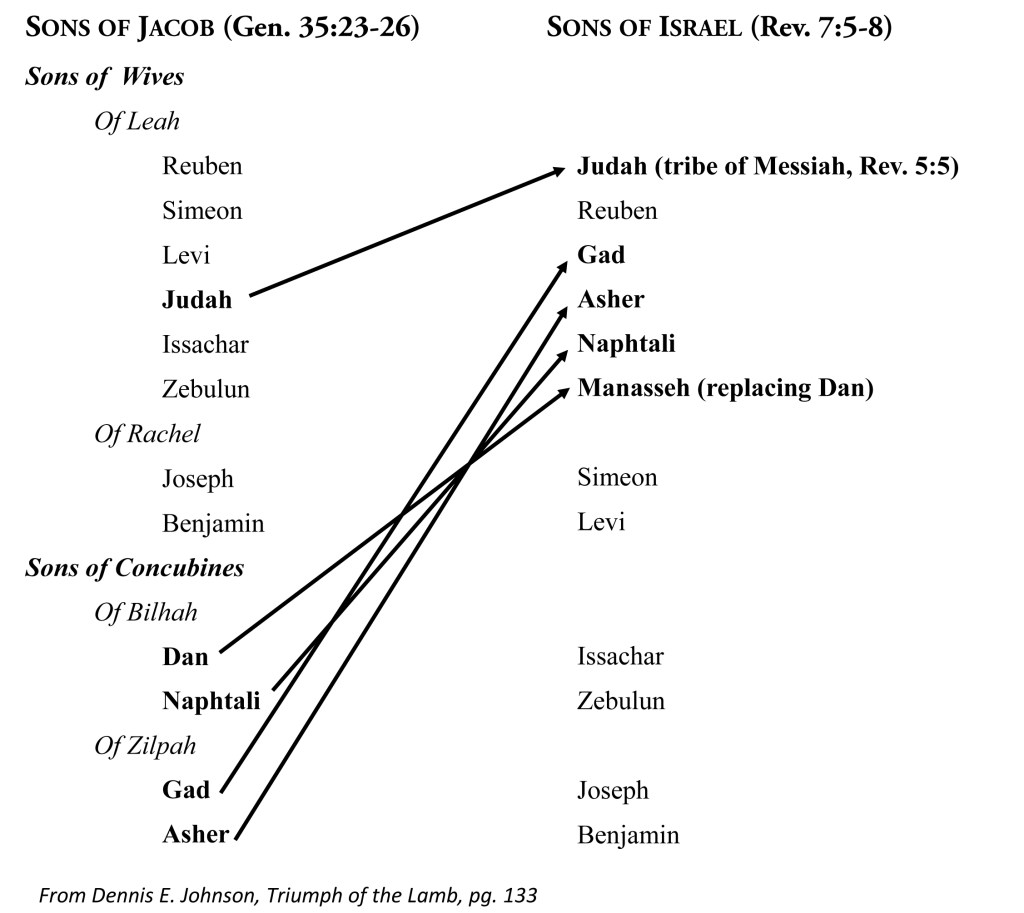
Adapted from Dennis E. Johnson, Triumph of the Lamb (130-134):
The list of the 12 tribes does not correspond to any of the lists in the Old Testament. If we think of the 12 sons of Jacob, we are puzzled by the presence of Manasseh, Jacob’s grandson, and the absence of Dan. If we think of the 12 tribes who inherited the land, we cannot explain why Joseph appears along with his son Manasseh but not Ephraim and why Levi appears, since this tribe did not receive an apportion territory – the LORD was Levi’s inheritance (Dt. 10:9-10).
Christopher Smith has offered a clear and persuasive explanation of the selection and order of the tribes listed in Revelation 7 (see graph below). The disparity of selection between this list and the Old Testament lists of Jacob’s sons and Israel’s tribes show that the twelve tribes in Revelation are symbolic with respect to the quantity and the ethnicity of the Lamb’s army… The order in which the tribes are listed shows that its purpose is to symbolize the inclusion of the Gentile nations into this sealed and protected people of God. The starting point is the list of Jacob’s twelve sons in Genesis 35:23-26, immediately following the accounts of the birth of the twelfth, Benjamin, and the incest of the first, Reuben – an act that would lead to Reuben’s loss of the firstborn son’s leadership and inheritance privileges (Gen. 49:3-4; I Chron. 5:1-2). The following changes (see graph below) in the order from Genesis 35 explain the order in Revelation 7 in harmony with the theology of Revelation as a whole. Judah is promoted from fourth position to first as the tribe of the Messiah, Jesus. The sons of the concubines (technically slaves of the competing wives Leah and Rachel, pressed by their mistresses into service as surrogate mothers) are promoted from the end of the line to positions three through six, above six of the sons of the wives, Leah and Rachel. The elevation of these descendants of women who were outsiders to the covenant family signifies the inclusion of the Gentiles among “the bond-servants of our God” (Rev. 7:3; 1:1). Dan, however, is replaced by Joseph’s son Manasseh because the tribe of Dan became notorious in Israel’s history for leading the northern kingdom into idolatrous apostasy (Judg. 18; I Kings 12:29-30)… Thus the order of the tribes in Revelation 7 symbolizes the reign of Jesus, from the tribe of Judah; the incorporation of outcasts; and the exclusion of idolaters from the covenant community that God shields from his terrible wrath.
Conclusion
Understanding the 144,000 is a symbolic reference to the true church ‘militant’ not only fits with the symbolic nature of Revelation, it fits with the rest of what the New Testament reveals. What is being taught theologically in Revelation is no different than the theology of the rest of the Bible. As the last New Testament book does not bless its ‘church’ readers by focusing on events that will happen to a limited group of people in a time and situation that the churches – will never have to face. What is different than, say the writings of Paul, James or Peter, is the style – it’s apocalyptic, using symbolic imagery. But the many images teach the same realities Apostle Paul teaches for the church. The realities of God’s sovereignty over all creation; the satanic/demonic influence among humans; man’s own sin and rebellion against God; Christ building His Church from those whom the Father gave Him– saving a vast yet definite number of people (144,000/great multitude) from every place in every generation; those redeemed persevering in faith amidst suffering; standing for truth though it cost some even their lives; looking for the blessed hope.
*Much appreciation to Pastor Mark McAndrew and his elders at North Avenue Church, Athens, GA for helping me think this through.
 teddmathisdotcom
One thought on “Who are the 144,000?”