- BECAUSE it fits the flow of the immediate text: Jesus is enabling His disciples to warn others of their generation of great tribulation to come in their lifetime. “You must flee Judea because of the desolation that is coming” (24:1515/Lk. 21:20).
2. BECAUSE the descriptions Jesus uses in 16-20 clearly describes tribulation occurring in the places, provinces, and covenant life of their day.
a. Those who are in Judea must flee to the mountains…” Judea was a term defining an area by the Roman Empire. But it was not always called that, nor would it continue to be.
b. Whoever is on the housetop…” Flat top houses were common during that time and commonly used by the people in Judea.
c. “Pray your flight will not be on a Sabbath…” This would occur when the Mosaic Covenant prohibited work and travel on the Sabbath in Judea. {For comparison, a 2022 article in The Times of Israel reported of the high number of communities in modern Israel permitting the sale of food on the Sabbath (74%). Transportation is available even in highly religious Jerusalem. Across the country, enforcement of Shabbat (Sabbath) laws is ‘uniformly lax’ a study had showed.}
3. BECAUSE of the way the Greek term “thlipsis megas” (literally, ‘affliction great’) is used elsewhere in the New Testament: See Acts 7:11; Rev. 2:22. It’s a hyperbolic (extreme exaggeration) term used to emphasize significant trouble or period of suffering or distress — not only one last/final time of tribulation.
4. BECAUSE this kind of hyperbolic language is also seen in the Old Testament but does not reference only one last/final time of tribulation.
a. Exodus 11:6 – “Moreover, there shall be a great cry in all the land of Egypt, such as there has not been before and such as shall never be again.”
b. Ezekiel 5:9 (when Babylon destroys Jerusalem) – “And because of all your abominations, I will do among you what I have not done, and the like of which I will never do again.”
c. Daniel 9:11-12 (Daniel’s lament as to what had happened to Israel as a result of their decades of idolatry {see Dt. 27:15-26}) – “Thus He has confirmed His words which He had spoken against us and against our rulers who ruled us, to bring on us great calamity; for under the whole heaven there has not been done anything like what was done to Jerusalem.”
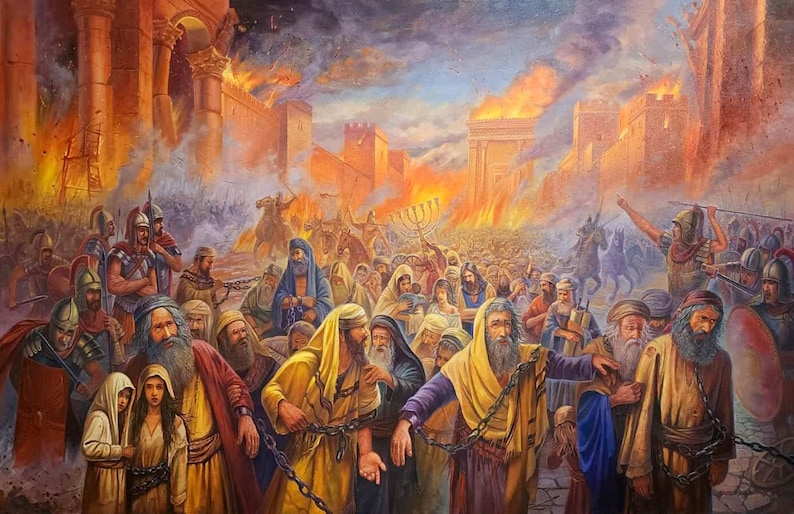
5. BECAUSE of the horrific brutality, starvation, and deaths of such a high number of Jews in such a condensed area and time. There was every reason to call it a ‘great tribulation.’ “The Jewish historian Josephus claimed that 1.1 million people, most of them Jewish, were killed during the siege, so that bodies were literally piled up around the altar. The usual population of Jerusalem was likely enlarged given that many had come to the city to celebrate the Passover, which was to occur right as the siege was being launched. Prior to the siege, the Romans had allowed Jewish worshippers to enter the city for the feast, but they did not allow them to leave” *. Also from Josephus: “Savagery, slaughter, disease, famine (mothers eating their own children) was monstrous… unequaled from the beginning of the world until now” (DAC** quoting from Josephus, War V, 424-38). “There have been greater number of deaths – six million in the Nazi death camps, mostly Jews, and an estimated 20 million under Stalin – but never so high a percentage of a great city’s population so thoroughly and painfully exterminated and enslaved as during the Fall of Jerusalem” (DAC**, 501).
6. BECAUSE of what Jesus tells the weeping women on His way to the cross to anticipate for themselves and their children – Luke 23:26-31. It fits with his descriptions of the great tribulation spoken of in Luke 21:20-24; Matt. 24:16-20; Mark 13:15-19.
7. BECAUSE of the distinguishing between apostate national Israel and true believers in Matthew 24. Jesus had just pronounced judgment (“woe”) on the scribes and Pharisees for their false teaching, works righteousness and therefore their rejection of Him as Messiah (Mt. 23:1-36). But note 23:36 –The reference is to “this generation.” The reason is because the majority of the people did not turn from their influencers and leaders to Jesus as their Messiah. Consider 23:38 (w/ 36) –Disaster for Israel as a nation is declared and is imminent. This would be divine earthly judgment upon unbelieving Israel as a nation, a judgment those united to Christ were not under; hence could rightfully flee.
a. Matthew 24:4-51 is Jesus’ wise response to His disciples’ questions in 24:3. These are Jewish men confessing Jesus as the Christ who’ve never been out of Judea and Galilee and only know life from the Mosaic Covenant perspective. Even at this point, they couldn’t fathom the uniting of Jews and Gentiles into One New Man by faith in Christ (see Ephesians 2:11-22), let alone calling Gentiles with bacon on their breath the true circumcision (Phil 3:2-3). Yet within 15-20 years, they would be defined by that reality, embrace it, and come to defend it (Acts 15; Galatians 2; I Peter 2:4-10).
b. His answer is necessarily then more a compilation of word pictures or scenes giving these Mosaic Covenant/Judaism-defined men a sense of what will be experienced until His return and less a chronology. The extended period of time (to which He does not give a length) will be characterized by wars, false prophets, apostasy, persecution and tribulation for Christ’s followers (the focus is not national Israel) even as the gospel of His kingdom goes forth through them to the whole world (24:4-14). From His first coming until His return, will largely be a time of tribulation (24:29; John 16:33; Phil. 1:29-30, etc.). His disciples (those with Him on the Mount of Olives) would live in the beginning of that era and experience those very things.
c. One of His scenes (14-21) zooms in on what will happen in 66-70 AD with the brutal response on the part of the Roman armies to the Jewish rebellion, including the final destruction of the temple. For unbelieving national Israel, it would be a time of great tribulation — something Christ’s followers are to anticipate and flee as they see it coming.
d. Note that after verse 21, while Jesus uses language His Jewish disciples could grasp, the focus is not on the physical temple or Judea/Galilee. He even uses the days of Noah (pre-Mosaic Covenant) to convey the kind of end of the age that should be anticipated (24:38-41). The focus is on what will be said and done in Christ’s name throughout the world (e.g., 24:23,24), and His elect that are throughout the world (24:31). He speaks of nothing from a local (Judea/temple) perspective. The only thing He points to is His return which won’t be a local event. It will be sudden, obvious and final for all everywhere (24:27-30; 37-44).
*Credit to Pastor Mark McAndrew, North Avenue Church, Athens, GA for helping me think this through.
**DAC = DA Carson, Commentary on Matthew, Expositor’s Bible Commentary
 teddmathisdotcom